
Your Mitochondria Are Keeping Score
(Or: “How to Age More Slowly, Enjoy Life More Fully, Have More Consistent Energy, and Prevent Chronic Disease”)
© Copyright 2026 by Dr David Meredith, DAc
Most of us learned the same thing in high school biology: mitochondria are the “powerhouse of the cell.” ATP, energy, done. This is all true but, as it happens, a serious understatement!
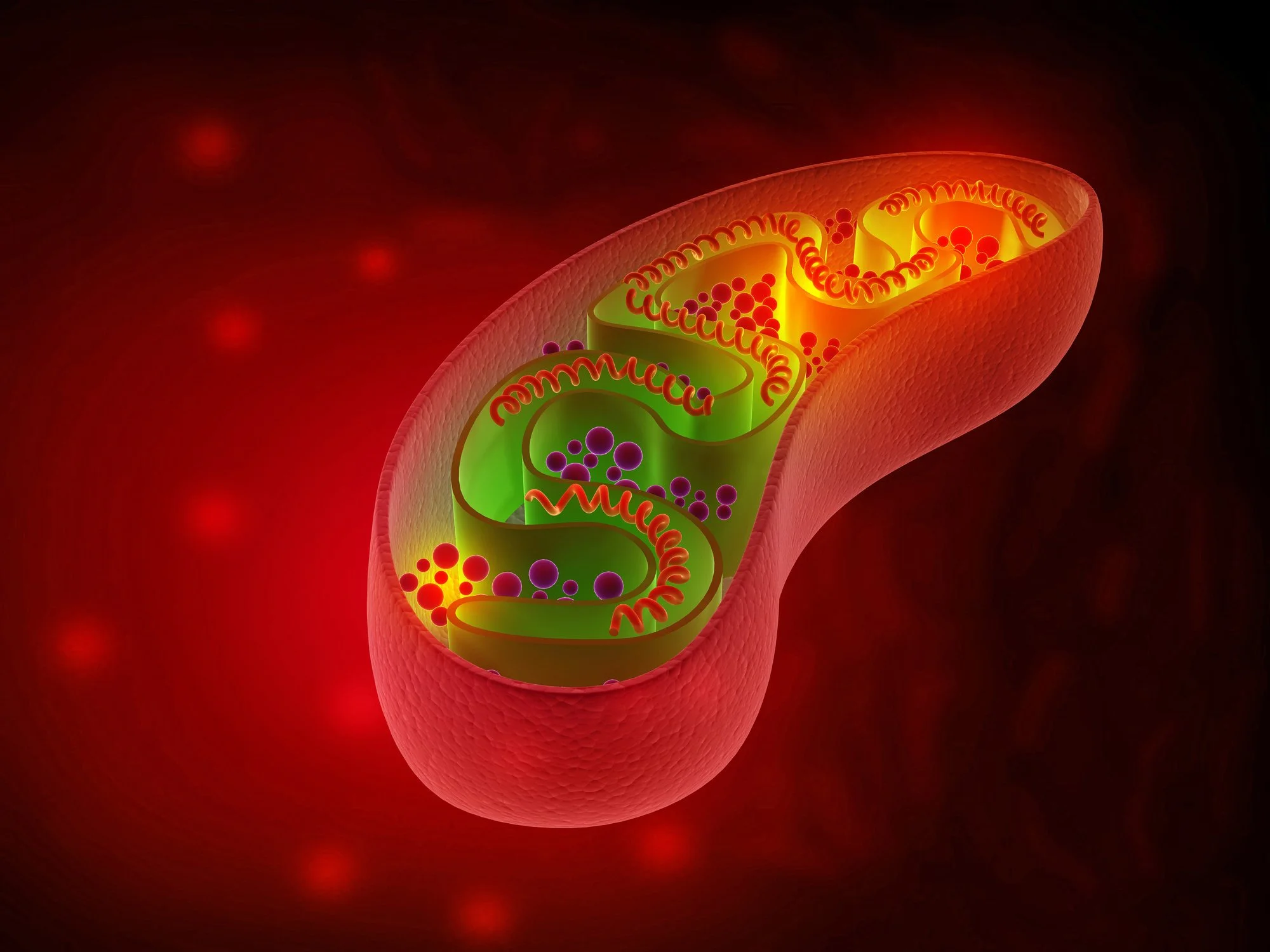
The more researchers look at mitochondria, the clearer it becomes that these cellular organelles aren't just chugging away in the background, providing us with the fuel we need to get through the day. They're sensors. They register light, monitor your nervous system state, and respond to chronic stress, sleep quality, and the emotional weight of your week. To put it simply, they’re sorta judging you. And over time, they recalibrate based on what they're noticing.
OK, this may be a bit of poetic license, but it isn't fringe science. In 2018, Martin Picard at Columbia and the late Bruce McEwen at Rockefeller published a framework in Psychosomatic Medicine describing exactly this—what they called mitochondrial allostatic load, or “MAL.” The short version: your mitochondria translate your psychosocial experience into measurable cellular change that can have a major effect on your life.Chronic stress elevates the MAL and wears the mitochondria down, while calmness, recovery, and positive states recalibrate them in the other direction.
Why this matters
MAL is the cellular cost of carrying stress in your body. It's not a disease, but rather a condition—very common, very modern, and largely invisible to standard medical workups.
When MAL is high, you feel a particular kind of tired that just doesn’t go away, even when you get enough sleep. Along with that, your thinking moves a half-step slower, small irritations land bigger than they should, workouts deplete instead of energize, and your nervous system never quite unclenches.
Sustained over time, the picture gets more concerning. Chronic mitochondrial strain shows up in the research as accelerated cellular aging, persistent inflammation, and elevated risk for many of the conditions people most hope to outrun: including cardiovascular disease, metabolic dysfunction, cognitive decline, and depression. The everyday fatigue is the early signal; the long-term cost is your body aging faster than it has to.
When MAL goes the other way—when your mitochondria are well-fed by light, regulation, and recovery—the picture changes substantially. Energy returns, not like the temporary spikes of caffeine and blood sugar, but consistently. Sleep starts repairing what it's supposed to repair and preventing what it’s supposed to prevent. Thinking sharpens, and resilience returns. Workouts build you up rather than tear you down, mood stabilizes, and you may even find yourself feeling less old than your last birthday suggested.
People often describe it as feeling like themselves again. The biology backs that up: cells doing what cells are supposed to do.
Where Very Well comes in
The great news for all of us is that the Picard and McEwen framework cuts both ways. The same mitochondria that wear down under chronic strain respond just as readily to positive inputs, which means the condition is genuinely reversible. This recalibration—toward health, well-being, and energy; away from fatigue, low mood, premature aging, and looming chronic disease state—is real, measurable, and available to anyone who decides to work on it.
What's harder is finding the right place to do that work. This isn't really what a primary care visit is built to address. The medical model is brilliant at diagnosing acute disease, but mitochondrial allostatic load doesn't show up on a standard panel, and your bloodwork probably comes back looking more or less fine, even when you don't feel fine. How do you solve a problem that isn’t even quantifiable?
With our broad-spectrum, holistic, evidence-based, and enjoyable approach to holistic health and well-being, Very Well was built precisely for exactly those problems—for reversing them and even preventing them in the first place. In the case of MAL, three of our most popular services can target mitochondrial function directly. And together with all of their other benefits, this is a great reason to experience them for yourself. No more excuses! (And you know exactly who you are. Ha ha.)
Red Light Therapy: the fastest signal
Red Light Therapy has the cleanest mitochondrial story of anything we offer. The mechanism is called photobiomodulation. Brace yourself for some science: Specific wavelengths of red and near-infrared light pass through skin and get absorbed by an enzyme called cytochrome c oxidase, which sits inside your mitochondria in Complex IV of the electron transport chain. When that enzyme absorbs the light, it works more efficiently. ATP production goes up, oxidative stress markers go down, and cellular metabolism gets a measurable lift.
Our full-body Red Light Therapy bed delivers five wavelengths simultaneously (630, 660, 810, 850, and 980 nanometers), each of which can penetrate into different depths. With these powerful wavelengths, the surface of your skin all the way down to your deep tissue is getting therapeutic light at the same time. (The 980nm wavelength at Very Well reaches further than most beds can.)
What it feels like, in the bed, is mostly a low warmth. Brightness will envelop you (keep your eyes closed or wear the provided shades). You may feel like you’re absorbing the rays at a sunny (red) beach, except instead of getting burned by the sun, you’re getting healed and energized from the outside in. I’ve never seen anyone leave our RLT room not looking radiant and glowing.
And then, a few hours or a day later, you may feel another kind of brightness: more energy, clearer thinking, more elevated mood. In addition to mitochondrial, there are plenty of other potential benefits, too, and they’re all yours after this pleasant 16-minute session.
PEMF: the deeper recalibration
PEMF—pulsed electromagnetic field therapy—works through a different mechanism but lands in the same neighborhood: cellular energy and repair.
Our device pulses between 1 and 10 cycles per second, in the extremely low frequency range that overlaps with frequencies the earth itself generates. (The Schumann resonance, the planet's natural electromagnetic hum, sits at around 7.8 Hz, and our machine has a setting just for that. It’s my favorite one.) Research on low-frequency PEMF shows effects on mitochondrial membrane potential, ATP production, and calcium signaling. The FDA has cleared PEMF for healing non-union bone fractures since the 1970s, so this isn’t new science, but we understand more about it all the time.
What people feel after PEMF is less inflammation, less pain, better sleep, and a nervous system that gradually unclenches. And yes, more energy, although we usually hear it described as “calm energy.” The changes are cumulative across sessions. Most people don't realize how braced they've been until they aren't anymore.
Modern Sound Bath: the listening part
If Red Light is mitochondrial input via photons and PEMF is mitochondrial input via electromagnetic pulses, our Modern Sound Bath is mitochondrial input via something subtler. This is where the MAL framework's bidirectionality really shows up.
Our vibroacoustic beds deliver low-frequency sound (including the 40Hz gamma frequencies we've written about elsewhere, for enhancing cognition and preventing dementia) directly through the body. You don't just hear it, you feel it: in your bones, in your chest, in the muscles you didn't know were braced. What it tends to produce is a state of deep parasympathetic recovery, the kind of stillness that doesn't usually arrive on demand like this. In a single session, this can do work even a master meditator can’t achieve.
According to Picard and McEwen, that recovered state is itself an input, one your judgy mitochondria are reading and responding to. Sustained over weeks, and especially paired with Red Light Therapy and PEMF, sessions like these may help dial mitochondrial allostatic load downward, and dial your mental state upward.
Our Modern Sound Bath is the service people most often describe as the most deeply and quickly altering. We have programs for calm, recovery, focus, creativity, joy, and other brainwave states that help our clients live more fully in the moment and over time.
What you're really booking
Here's the upside of having judgy mitochondria: they have short memories. Whatever they've been registering this past year—the deadlines, the bad sleep, the stress you've been carrying—isn't locked in. They're already looking for what you’ll give them next.
Very Well can make what comes next worth the wait. You don't have to believe in anything, commit to a lifestyle, or fully grasp the science (though we'll happily talk you through any of it). You just have to show up once or twice a week until you feel better. The biology takes it from there.
Better energy, better sleep, sharper thinking, slower aging, a body that recovers like it should. These are what happens when your mitochondria start releasing the stress they didn't ask for.
(Please enjoy our new jingle: 🎵 “Your mitochondria deserve a break today… at Very Well Optimal Living Center in the Village of Cross Keys in Baltimore, MD, just off I-83 between Northern Parkway and Cold Spring Lane!” 🎵 )
Click BOOK NOW to schedule!